
The World Doesn't Trade on One Clock: How Trading Sessions and October Holidays Affect Markets
What if the same headline arrived at a different hour?
Same Headline. Different Market.
A major economic headline hits at 8:00 AM London time. Now picture the same release landing late in the Asian session. The information is the same. The market receiving it is not.
Trading sessions determine who is present when news arrives: which desks are staffed, how deep liquidity runs and which participants dominate order flow. That is why the same news can be priced very differently depending on when it lands.
The Global Trading Day: Three Major Sessions
TOKYO → LONDON → NEW YORK → REPEAT
The global trading day runs as a relay. Activity passes between financial centres rather than switching on and off, and the handovers between them often matter as much as the sessions themselves.
That participation is highly concentrated. According to the BIS 2025 Triennial Survey, global FX turnover averaged $9.6 trillion per day in April 2025. The UK accounted for 38% of activity, while the UK, US, Singapore and Hong Kong SAR together handled 75%.
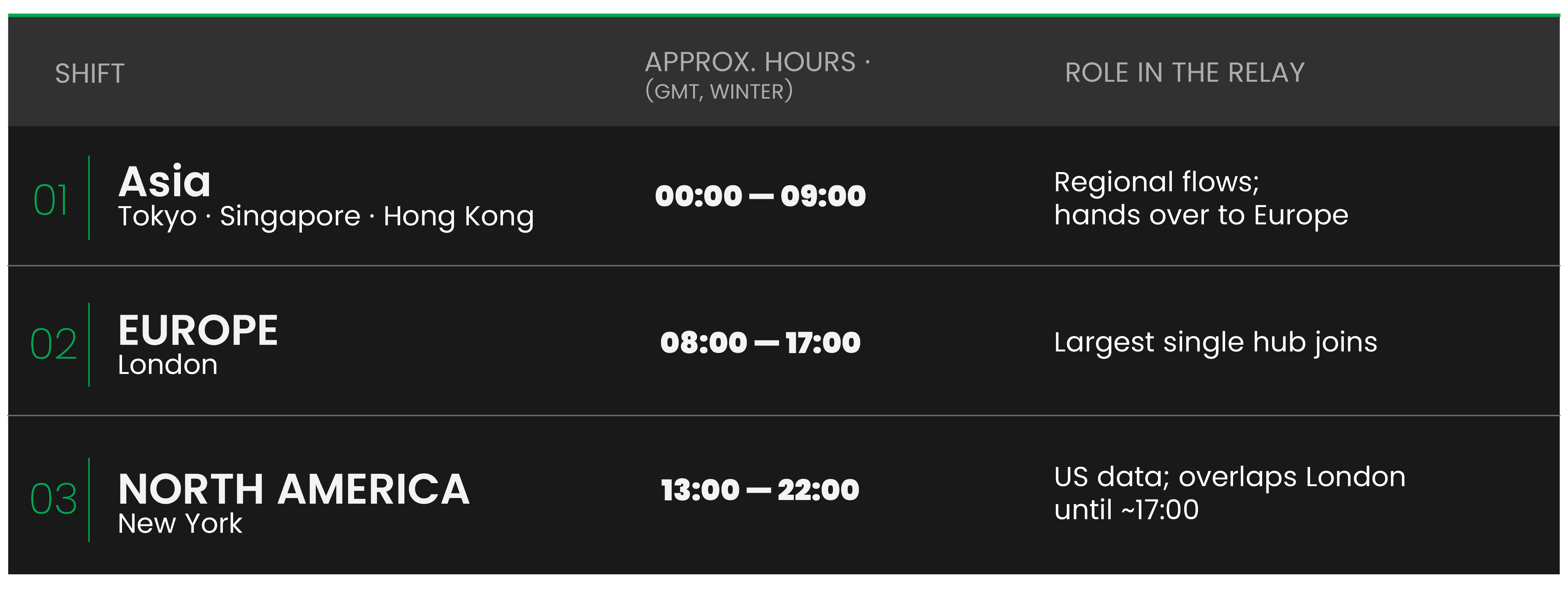
Reserve Bank of Australia research has found that FX turnover and volatility tend to be higher during the London–New York overlap. For the wider 24-hour picture, see how global markets create opportunity around the clock.
October Breaks the Rhythm
Holidays and clock changes temporarily redraw the relay. Two examples to mark on your October 2026 calendar:
China's Golden Week. Mainland venues, including the Shanghai Gold Exchange, close from 1 to 7 October and reopen on 8 October. One of Asia's largest pools of market participants steps away for a full week, which can thin out activity in China-linked assets.
Europe's clock change. UK clocks go back on 25 October; US clocks follow on 1 November. For that one week, London and New York sit four hours apart instead of five, so a US release scheduled for 8:30 AM New York lands at 12:30 in London, not 13:30.
The point isn't "holiday = volatility." It's that the market conditions you normally expect may look different for a while, and it pays to know that in advance.
The Hidden Variable: Participation
Two chains explain most of what shifts:
- Fewer participants → different liquidity conditions → different execution environment → potential changes in spreads and price behaviour.
- Session overlap → more participants → deeper activity → faster information absorption.
Research using EBS foreign-exchange data by Takatoshi Ito and Yuko Hashimoto found a strong positive relationship between trading activity and volatility, while bid-ask spreads generally narrowed when activity increased. In other words, who is active, and when, can materially change the trading environment.
These are market mechanics, not guaranteed outcomes.
Think in Market Time, Not Just Clock Time
Before you react to a headline, run these five quick checks:
- WHO is active? Which financial centres are open, and which are on holiday?
- WHERE is liquidity concentrated? Inside an overlap, or in a single-session lull?
- WHAT market is affected? A China-linked asset during Golden Week trades in a different environment from EUR/USD at the London open.
- WHEN does the next major session open? Fresh participants can confirm a move or reverse it.
- on the economic calendar? The following release may matter more than the last.
One Global Market. Many Moving Parts.
DB Investing helps traders keep that context visible. The Economic Calendar tracks scheduled releases, while live market prices show how conditions are developing across asset classes. The AI Signal Centre adds technical market analysis, with Acuity signals also available by email on a daily or weekly basis.
None of these predict what happens next. They help you see the environment you are trading in, so you can plan with more context.
Three Hours Later
If that 8:00 AM headline arrived three hours later, would the market react exactly the same way? Maybe. Maybe not.
Traders don't operate in a market that is simply open or closed. They operate in one where participation moves continuously around the world, and understanding that rhythm is one of the simplest ways to trade with more awareness.
See the market in context with DB Investing.