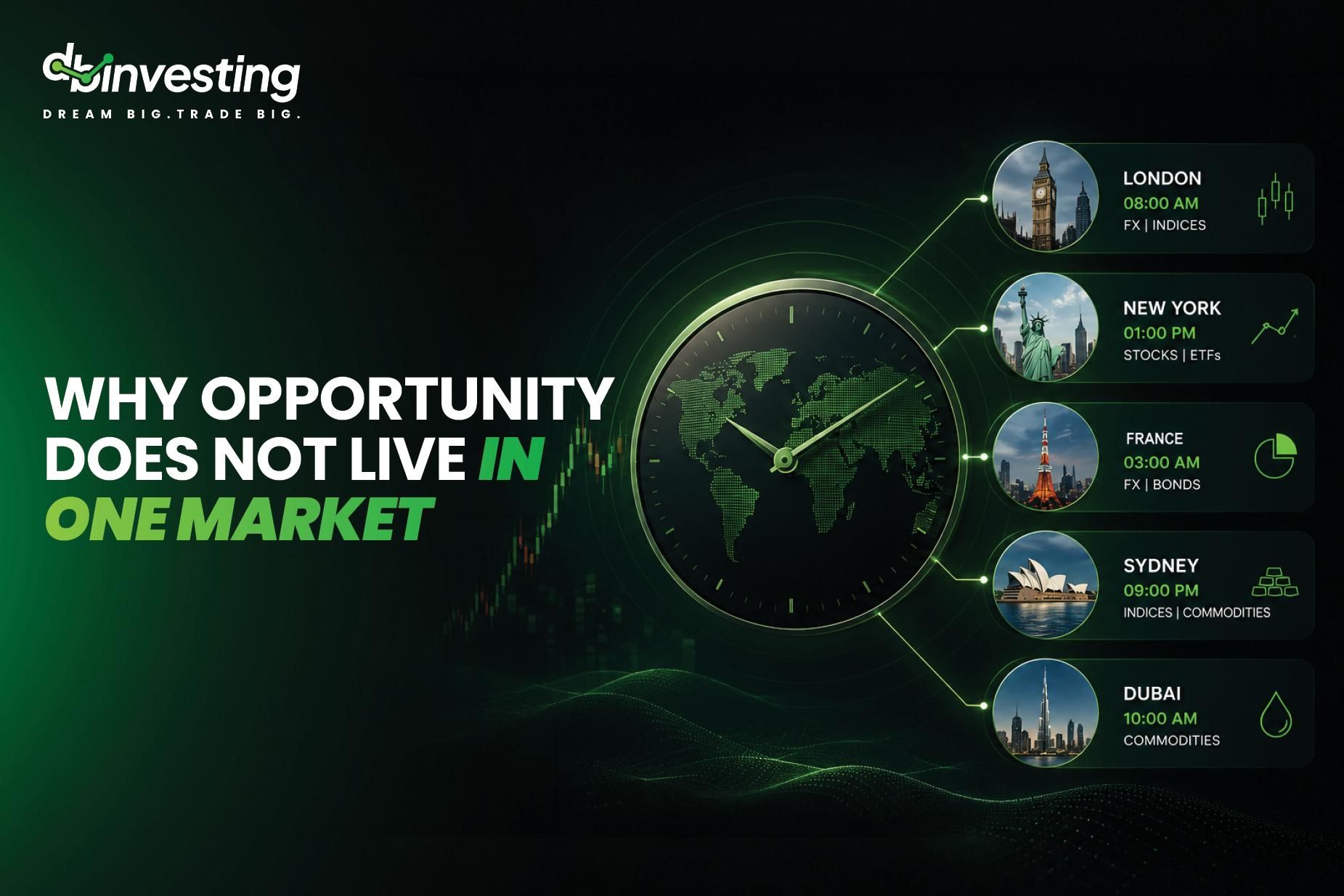
Discover why restricting your trading to a single market can quietly cost you time, capital, and edge — and how a multi-asset approach opens up opportunity around the clock.
It's common for traders to spend years focused on a single asset class. They study one currency pair, stick strictly to US equities, or trade gold futures exclusively. Mastering a single instrument builds real confidence and discipline — but relying solely on one asset class can leave you with significant blind spots.
The Unseen Costs of Single-Market Tunnel Vision
Single-market tunnel vision carries subtle risks that can quietly drag down your overall performance:
- Low-volatility traps: Financial instruments routinely enter extended consolidation phases. Forcing trades in a range-bound market with weak conviction often leads to unnecessary losses.
- Ignored intermarket correlations: Markets don't move in isolation. Shifts in central bank interest rates drive currency movements, oil price swings ripple through energy stocks, and tech earnings feed directly into broad market indices. Watch only one market and you miss the signals forming in the others.
- Concentrated risk: Keeping your entire portfolio tied to a single asset class leaves you fully exposed during sudden market shocks or unexpected regulatory changes.
Why Multi-Asset Trading Changes the Game
Expanding your scope across multiple global markets changes how you approach every trade setup.
- Capture 24/5 Global Session Momentum Global markets operate on a rolling clock five days a week. As the Asian session winds down, Europe opens, followed shortly by Wall Street. Multi-asset access lets you follow high-volume liquidity windows regardless of your location or local time zone — so opportunity doesn't clock out when your home market closes.
- Seamless Sector Rotation Institutional capital flows dynamically. During economic expansions, money often moves into growth equities and industrial commodities. In periods of uncertainty, it rotates into safe-haven currencies or precious metals. Trading across sectors lets you follow where the volume is actually flowing, instead of waiting for it to return to you.
- Enhanced Risk Management and Diversification Uncorrelated markets offer a distinct advantage. Spreading positions across instruments that don't move in lockstep — such as pairing a forex trade with a position in indices or commodities — helps balance overall portfolio volatility and mitigates single-event downside risk.
How DB Investing Unlocks Global Opportunities
Navigating multiple financial markets requires a broker that provides the right infrastructure, regulatory oversight, and reliable execution.
DB Investing offers a comprehensive environment built for multi-asset traders:
Thousands of tradable instruments: Access a broad range of CFDs — including Forex, global indices, stocks, commodities, energies, and cryptocurrencies — all from a single trading account.
- Multi-regulated and secure: Trade under multi-jurisdictional oversight, including the Financial Services Authority (FSA) of Seychelles, the Capital Market Authority (CMA) in the UAE, and the Financial Services Commission (FSC) of Mauritius, with client funds held in segregated accounts.
- Industry-standard technology: Execute strategies on MetaTrader 5 (MT5), featuring fast execution, advanced charting, automated trading capabilities, and deep liquidity.
- Competitive trading conditions: Gain an edge with tight spreads from 0.01 pips, flexible leverage up to 1:2000, negative balance protection, and dedicated multilingual support.
Final Thoughts
Opportunity doesn't live in just one market — it lives wherever liquidity, volume, and volatility align. By stepping beyond single-asset limitations and adopting a multi-asset strategy, you position yourself to capture setups across global markets.
Ready to broaden your trading horizon? Explore global markets today with DB Investing.
Trading CFDs and leveraged products carries a high level of risk and may not be suitable for all investors. You could lose more than your initial deposit. Ensure you fully understand the risks involved and seek independent advice if necessary.