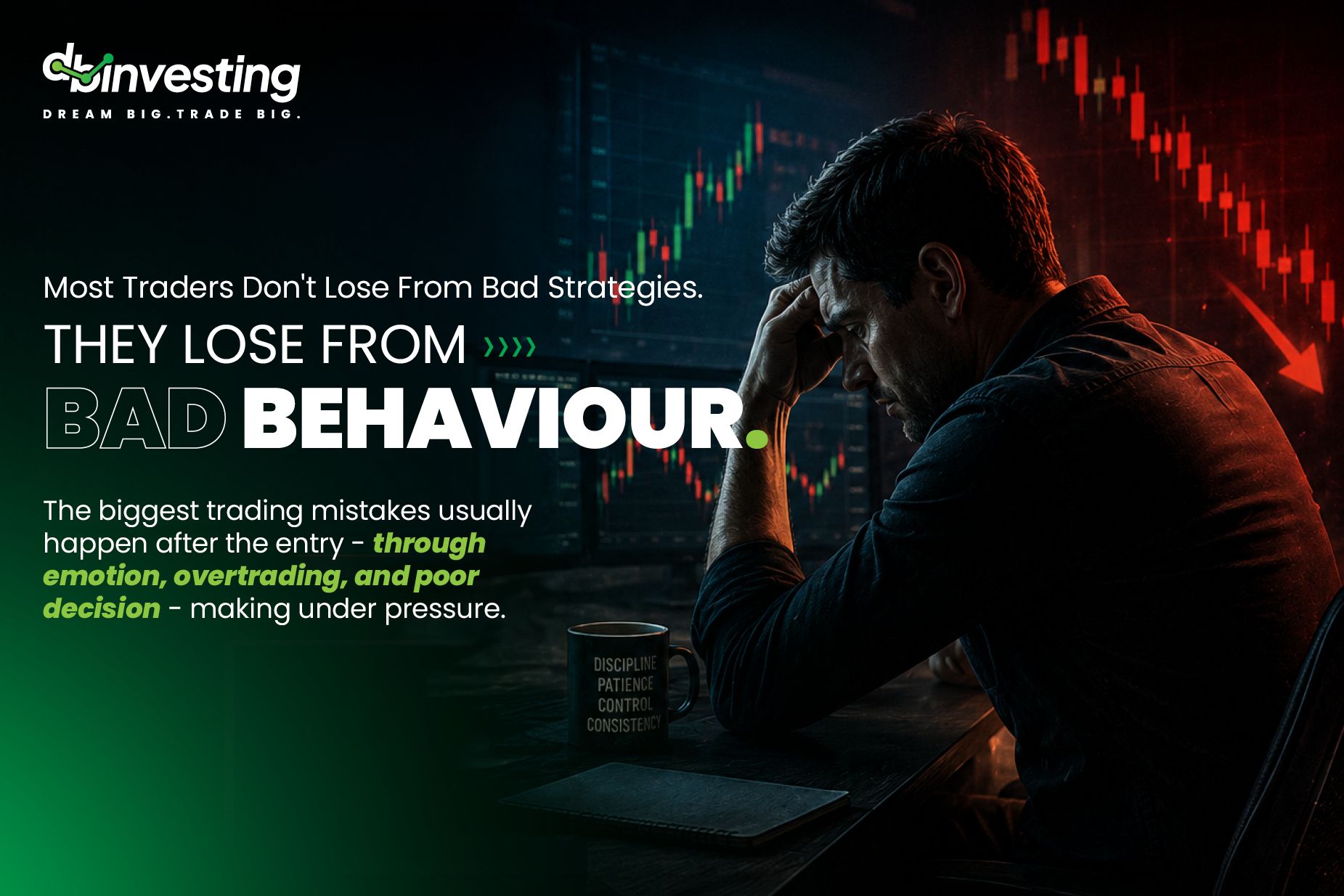
Most traders spend years chasing the perfect strategy, indicator, or signal.
But many losses happen after the setup is already valid.
The entry is rarely the real problem.
The behavior that follows is:
- Moving stop losses
- Revenge trading
- Overleveraging
- Exiting too early
- Chasing missed moves
Modern platforms provide instant access to global markets.
But access without discipline creates emotional trading environments that quietly erode consistency
over time.
Why Emotion Overrides Structure
The human brain is wired to react emotionally to uncertainty, loss, and volatility.
In trading:
- Losses feel stronger than gains
- Fear creates hesitation
- Greed encourages overexposure
- Stress weakens decision-making
That is why many traders abandon their own rules in live markets, even when their strategy is still
statistically sound.
Overtrading: The Silent Account Killer
More trades do not automatically mean more opportunity.
Overtrading often comes from:
- Boredom
- Emotional recovery attempts
- Fear of missing out (FOMO)
- Impatience during consolidation
High-frequency emotional trading increases exposure while lowering decision quality.
Disciplined traders accept that sometimes the best trade is no trade.
Risk Management > Win Rate
One of the most common misconceptions is that profitability comes from being right most of the time.
Professional traders focus more on:
- Risk‑to‑reward ratios
- Position sizing
- Maximum drawdown limits
- Consistency over hundreds of trades
You can be profitable with a lower win rate if your losses are controlled and your winners are managed
with intention.
The Market Is Not Random
Markets are influenced by liquidity, positioning, macroeconomic expectations, and crowd behaviour —
rather than by pure randomness.
Understanding:
- Market structure
- Volatility cycles
- Liquidity zones
- Momentum behavior
gives traders context, so decisions come from structure rather than emotional reaction.
Trading Is a Decision-Making Environment
The difference between profitable and unprofitable traders is rarely intelligence.
It is usually:
- Emotional control
- Structured execution
- Patience under pressure
- Consistency during volatility
Successful trading is not about killing emotion. It is about building systems and habits that stop emotion
from controlling execution.
Trade With More Structure at DB Investing
Trade global markets with more structure, discipline, and clarity with DB Investing:
- Multi‑asset access to 20,000+ instruments across forex, indices, stocks, commodities, metals, and
crypto
- Lightning‑fast execution on MT5
- AI‑powered tools and Signal Centre to support data‑driven decision-making, not emotional guessing
Explore the DB Investing platform today and start treating trading as a professional
decision‑making process — not an emotional reaction.